The True New Year Reset: Balancing Your Hormones After Holiday Chaos
Every January, we’re sold the same story:
“Start fresh.”
“Detox your body.”
“Reset your metabolism.”
But by mid-month, so many people still feel exhausted, bloated, moody, and unmotivated. They’re left wondering why the “reset” didn’t work.
What you’re feeling after the holidays isn’t a lack of discipline. But it could be a sign your hormones are out of balance.
The Post-Holiday Hormone Crash
The holidays are a perfect storm for hormone disruption. More stress. Less sleep. More sugar and alcohol. Less structure.
Even just a few weeks of that can throw off your internal rhythm, especially if you were already running on empty before the season began.
You might notice:
You wake up tired but can’t fall asleep easily.
You’re craving carbs or sweets constantly.
You feel puffy or bloated.
Your mood and motivation are unpredictable.
Your workouts suddenly feel harder.
These aren’t signs that your body needs a “detox”. They are often signs your hormones are trying to recover.
The Physiology Behind Feeling “Off”
Here’s what’s really happening beneath the surface:
Cortisol, your main stress hormone, spikes with travel, deadlines, and disrupted sleep. That surge can slow your metabolism, increase bloating and fatigue, worsen mood swings, disrupt your cycle, and tank your libido.
Insulin becomes less sensitive after a season of holiday meals, decadent desserts, and champagne toasts, leading to more fat storage, mid-day energy crashes, and sugar cravings.
Estrogen and progesterone shift in response to stress, which can cause mood swings, anxiety, and water retention.
Testosterone can dip when stress runs high or inflammation builds so that workouts feel harder, recovery takes longer, and that inner drive that used to come naturally feels harder to access.
You feel like your body isn’t cooperating, even when you’re trying to do everything right.
Why Detoxes Don’t Work
When you feel this way, it’s tempting to turn to quick fixes: juice cleanses, fasting challenges, “hormone detox” kits. But detoxing your body into submission isn’t the answer. Hormones don’t respond to deprivation. They respond to stability.
Most “detox” plans actually make hormonal balance worse by:
When you slash calories or skip meals, your body sees it as stress. Cortisol rises, your thyroid slows down, and blood sugar swings harder.
The result? The very system that’s meant to support your hormones ends up overloaded.
Your body isn’t asking for a cleanse. It’s asking for regulation.
The Real Reset: Hormone Optimization
A real reset starts with restoring communication between your hormones and your metabolism.
That means:
Testing your hormone and metabolic labs to see where stress has taken its toll
Supporting recovery with nutrition and targeted supplementation
Balancing blood sugar through steady, protein-rich meals and medications as needed
Prioritizing morning light and consistent sleep to reset your circadian rhythm
Once your hormones are in sync, everything else starts to align:
Your energy steadies. Your mood lifts. Your metabolism responds again.
And that’s the difference between chasing wellness trends and building true hormonal health.
A Reset That Lasts
Your body doesn’t need punishment after the holidays. It needs a partnership.
By focusing on hormonal balance instead of detox culture, you create a foundation for energy, focus, and longevity that actually lasts. Because when your hormones are balanced, your body knows exactly what to do.
Connect with us today to learn about our hormone optimization program.
Get You a Health Optimization Plan That Can Do Both: HRT and GLP-1s
Why Women Deserve More Than One Tool
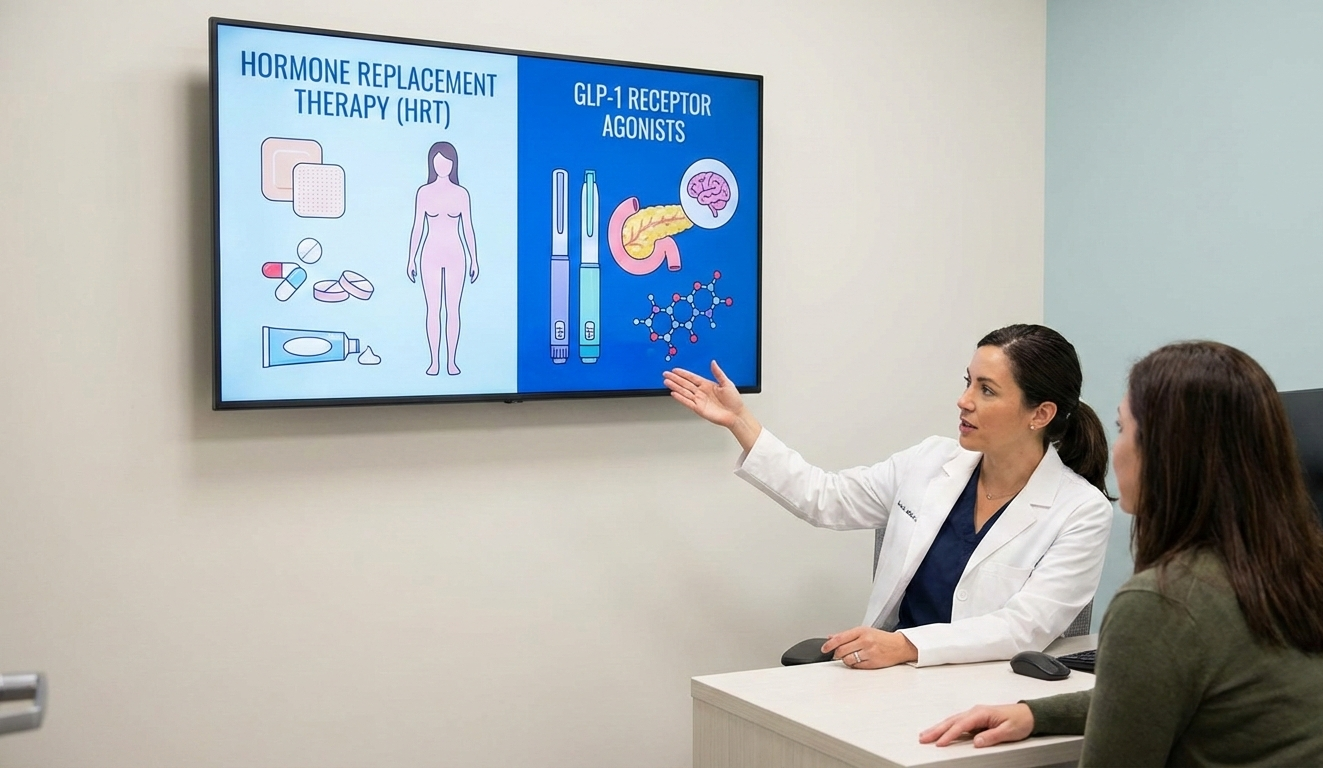
For decades, women in perimenopause and menopause have been told that weight gain is inevitable. Hormone replacement therapy (HRT) helped improve hot flashes, sleep, and mood, but the scale often didn’t move. Meanwhile, GLP-1 receptor agonists, like semaglutide and tirzepatide, have made headlines for their powerful weight-loss results.
A growing body of research, including a 2024 study, suggests something important: when used together, HRT and GLP-1s may create greater weight loss benefits than either therapy alone.
This is where medical synergy comes in.
What Is HRT?
Hormone replacement therapy restores declining hormones like estrogen, progesterone, and sometimes testosterone to more balanced levels. In women, this may:
Improve sleep, mood, and brain clarity
Reduce hot flashes and night sweats
Support bone density and muscle preservation
Improve vaginal and sexual health
Enhance overall quality of life
But when it comes to weight loss, HRT has limits. Balanced hormones create a healthier metabolic “playing field,” but HRT alone rarely drives significant fat loss.
What Are GLP-1 Medications?
GLP-1 receptor agonists, such as semaglutide (Ozempic, Wegovy) and tirzepatide (Mounjaro, Zepbound), mimic a hormone your gut naturally produces. They work by:
Reducing appetite and cravings
Slowing digestion to increase fullness
Improving blood sugar control
Lowering systemic inflammation
These effects make GLP-1s a powerful tool for weight management and metabolic health.
Why Combining HRT and GLP-1s Works Better
The new study highlights a clear finding: women in perimenopause lost more weight when using both HRT and GLP-1 therapy compared to GLP-1s alone.
Here’s why this synergy makes sense:
HRT addresses the hormonal backdrop: Low estrogen contributes to insulin resistance, belly fat, and muscle loss.
GLP-1s address appetite and metabolism: They help curb cravings, balance blood sugar, and lower inflammation.
Together, they create a complete approach: HRT sets the stage; GLP-1s accelerate the results.
Think of it as fixing the foundation (hormones) and remodeling the house (metabolism) at the same time.
Real-World Benefits for Women in Midlife
When women combine these therapies under medical supervision, the benefits may include:
Greater and more sustainable weight loss
Improved energy and sleep
Better body composition (more lean muscle, less fat)
Reduced frustration and plateaus on GLP-1s alone
Confidence that the root causes, not just the symptoms, are being addressed
Is It Right for You?
Not every woman is a candidate for HRT or GLP-1 therapy, and safety monitoring is essential. But for many in perimenopause or menopause, the combination may offer the most comprehensive support for both health span and weight management.
If you’ve felt frustrated by slow progress on weight-loss medications or you’re navigating hormone changes, this is a conversation worth having with a provider who understands both therapies.
You Deserve All the Resources
The future of women’s health isn’t about choosing between hormones or modern weight-loss tools. It’s about integrating them. HRT restores the balance. GLP-1s drive metabolic momentum. Together, they may change the way we approach perimenopause, menopause, and long-term metabolic health.
It Takes Two: Why Men’s Health Matters for Pregnancy and Baby’s Future
Shifting the Focus
When couples struggle to conceive, the spotlight often shines on women. Hormones, cycles, ovulation tracking, egg quality. It’s all placed under the microscope. But here’s a truth that often goes unspoken: men contribute 50% of the DNA to every pregnancy, and their health directly impacts fertility, pregnancy outcomes, and the lifelong health of their child.
At our practice, we believe men deserve just as much attention, testing, and support as women when preparing for fatherhood.
Men: Your Contribution Matters More Than You Think
Sperm health isn’t just about count. Quality, motility, DNA integrity, and even environmental influences all matter. Research shows that a father’s health before conception may affect:
Fertility success rates like the time it takes to become pregnant, and degree of miscarriage risk
Pregnancy outcomes like risk of pregnancy complications, growth restriction in the baby, or preterm birth
Long-term child health related to metabolic and cognitive functioning
In other words: supporting men’s fertility is supporting the whole family.
What Gets Overlooked in Men’s Fertility
While women often undergo extensive evaluations, men are frequently told to “just try” without guidance. Yet male fertility can be influenced by:
Hormonal imbalances (testosterone, thyroid, prolactin, cortisol)
Nutrient deficiencies (zinc, vitamin D, antioxidants)
Lifestyle stressors (sleep, alcohol, toxins, sedentary habits)
Weight, insulin resistance, and metabolic health
Environmental exposures (endocrine disruptors, plastics, pesticides)
These factors can reduce sperm quality and impair fertility, even if a man’s sperm count is normal.
How Our Practice Helps Men Optimize Fertility
At our clinic, we take a precision approach because fertility isn’t one-size-fits-all. Here’s how we support men preparing for fatherhood:
Comprehensive Hormone & Lab Testing
Testosterone, thyroid, insulin, nutrient status, and inflammation markers.
Personalized (Pregnancy-Safe) Hormone & Metabolic Support
Hormonal and metabolic optimization through supportive therapies and lifestyle strategies
Targeted Nutrition & Supplementation
Antioxidant, micronutrient, and amino acid support tailored to sperm health.
Guidance on an anti-inflammatory, fertility-friendly diet.
Lifestyle & Environmental Coaching
Stress reduction, sleep optimization, and exercise planning.
Guidance on reducing toxins that may impair fertility.
Long-Term Health for Dad & Baby
Supporting the father’s health doesn’t stop at conception. Strong metabolic health lowers risks during pregnancy and improves longevity for both dad and baby.
Why This Matters for Couples
Fertility challenges are never just one partner’s responsibility. By addressing male health, couples can:
Improve their chances of conceiving naturally
Reduce the emotional toll of fertility struggles
Build a stronger foundation for pregnancy and child health
Share the responsibility, because fertility is a partnership
The Bottom Line
Women have long carried the pressure of fertility, but men’s role is just as vital. Optimizing sperm and hormonal health not only improves conception rates but also contributes to a healthier pregnancy and baby.
At Wild Roots Wellness, we’re here to support both partners with advanced testing, personalized therapies, and comprehensive care. Because building a family starts with both of you.
Ready to prepare for fatherhood? Schedule your consultation today and learn how we can help you optimize your health, your fertility, and your family’s future.